

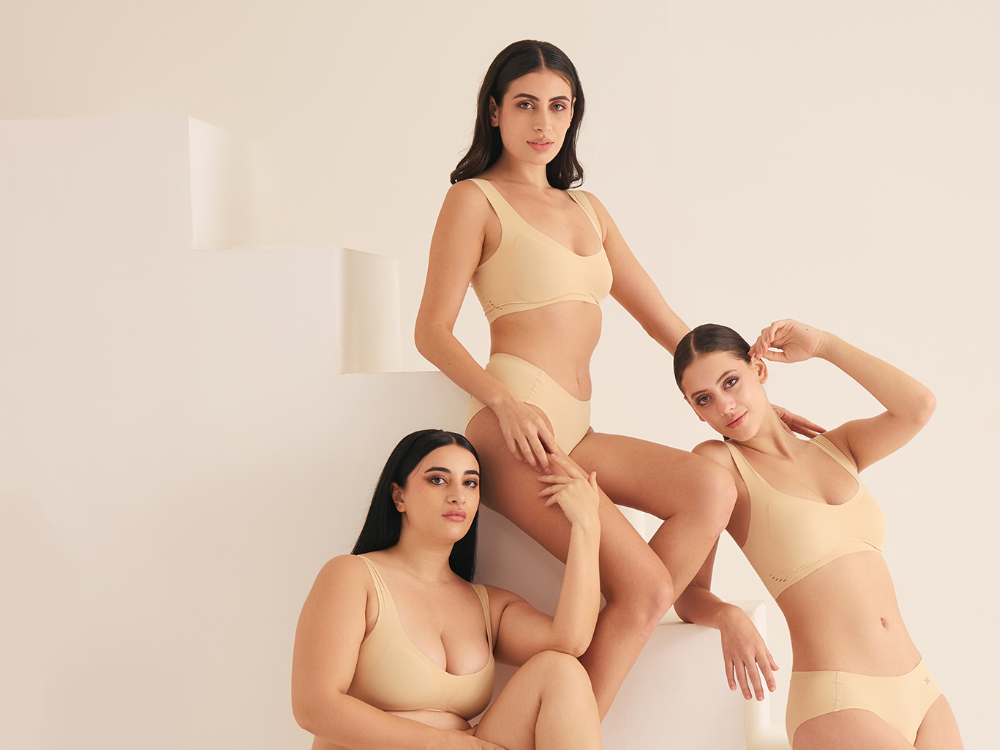
Decoding Your Bra Size: What A, B, C, D Cups Really Mean (No Measuring Tape Drama)
Key Takeaways
-
Cup sizes are relative. They represent the difference between your bust and band measurement, not a fixed breast size
-
The same cup letter means something completely different on every band size
-
Most women are in the wrong size because the system was never properly explained, not because they measured wrong
-
The band does most of the support work
-
Brand sizing varies; always treat your calculated size as a starting point
-
Re-measure periodically. Bodies change, and so does the fit
Why the Alphabet Has Been Misleading You
Here's what most of us were told: A is small, B is average, C is full, D is large. Clean, simple, and almost entirely wrong.
Cup sizes are not fixed measurements. They are relative ones and they only make sense when paired with a band number. A 32D and a 38D are not even close to the same bra. The letter D in both cases means something completely different, because the breast volume required to create that difference changes with the band size.
This is the part no one explains at the store counter, which is why most women spend years adjusting straps, tolerating underwires that dig in, and blaming their body for a problem that's actually about proportion, not size.
The Two-Number System: How Bra Sizing Actually Works
Every bra size is made up of two things:
-
Band size — the number (28, 30, 32, 34, 36, 38...) your ribcage circumference measured just below the bust
-
Cup size — the letter (A, B, C, D, DD...) — the difference between your bust measurement and your band measurement
|
Difference (Bust minus Band) |
Cup Size |
|
~1 inch |
A |
|
~2 inches |
B |
|
~3 inches |
C |
|
~4 inches |
D |
|
~5 inches |
DD / E |
|
~6 inches |
F |
So if your band is 34 inches and your bust is 37 inches, that's a 3-inch difference, making you a 34C. If your band is 32 inches and your bust is 35 inches, also 3 inches, you're a 32C. Same letter, very different bra. The proportions are not interchangeable.
Cup Size Is Not Breast Size
A D cup on a 30-inch band looks nothing like a D cup on a 38-inch band. The volume is different. The shape is different. The support requirement is different.
This matters because "D cup" has become cultural shorthand for large which means women with smaller band sizes and fuller busts often end up in bras that can't hold them, while women with larger band sizes move into higher letters when they may not need to.
There's a concept in bra fitting called sister sizing bras that share the same cup volume across different band-and-letter combinations:
|
Your Size |
Sister Sizes (same cup volume) |
|
32C |
30D / 34B |
|
34D |
32DD / 36C |
|
36B |
34C / 38A |
Sister sizing is useful when your exact size isn't in stock. But it's a workaround. The band fit will change, and that affects how the bra actually sits and supports.
How to Find Your Size in 3 Steps
Step 1 — Measure your band: Wrap a soft tape snugly around your ribcage, just below your bust. Keep it level and firm. Round to the nearest even number.
Step 2 — Measure your bust: Wrap the tape around the fullest part of your chest without compressing. Note the number.
Step 3 — Find the difference: Subtract band from bust. Match it to the chart above. Combine with your band number - that's your starting size.
Starting size, because fit also depends on the bra's construction, fabric, and style. A moulded T-shirt bra and a wireless bralette in the same size will feel different on the same body and both can be right.
Why Sizes Feel Different Across Brands
Bra sizing is not regulated or standardised. Every brand uses its own block patterns and grading systems, which means a 34B from one label may fit like a 34C from another. This is not a flaw in your measurement, it's a structural inconsistency in the industry.
Among Indian innerwear brands like Clovia, Enamor, Zivame, PrettySecrets, Krvvy each follows its own construction standards. Krvvy's sizing is designed to work across a range of body types rather than a single fit model, which makes it a reasonable starting point if you've struggled with inconsistent fit elsewhere. The Trueform Support Bra, for instance, is built for everyday hold without relying on rigid underwire, making fit more forgiving across band and cup combinations. The Ultrasoft Bralette works well for lighter coverage days, particularly in smaller to mid-range cup sizes.
The practical rule: go up or down one cup when trying a new brand before assuming your size is wrong. The calculation is usually right, the construction is the variable.
Bra Style vs. Fit: A Quick Reference
|
Style |
Best For |
Fit Note |
|
Underwired T-Shirt Bra |
Everyday structured support |
Follows size chart most closely |
|
Wireless / Soft Cup |
Comfort, lighter coverage |
May run slightly large consider sizing down in cup |
|
Bralette |
Minimal coverage, loungewear |
Usually S/M/L- check brand chart |
|
Strapless |
Occasion wear |
Go snugger in the band to compensate for no straps |
|
Stick-On / Adhesive |
Backless, deep necklines |
Sized by cup shape, follow brand guide |
FAQs
Is an A cup small and a D cup large?
Not necessarily. Cup letters describe a proportional difference, not an absolute size. A 38A holds more volume than a 28D. The number and the letter only mean something together.
How do I know my bra is the wrong size?
Straps falling off, underwire sitting on tissue, cups gaping or overflowing, band riding up your back any of these indicate a size or style mismatch, not a body problem.
Can my bra size change over time?
Yes. Weight changes, hormonal shifts, pregnancy, and age all affect fit. Worth re-measuring every year or two, or when your current bras start feeling noticeably different.
Why does my size seem different across brands?
Bra sizing isn't standardised globally. Each brand uses its own fit blocks. A 34B in one brand can fit like a 34C in another. Treat your size as a starting point and allow for one-cup variation with new brands.
How should a band fit?
Snug but not tight. Two fingers should fit underneath. It should sit level across your back and fasten on the loosest hook when new, so you can tighten as the elastic relaxes over time.
Are wireless bras okay for fuller cup sizes?
Yes, if the construction is good. A well-made wireless bra with strong seaming and a structured band can support larger cups comfortably. Fit still matters. A wireless bra in the wrong size won't perform regardless of how it's built.