

How to Tell if Your Bra Actually Fits (Most of Us Are Just Guessing)
Key Takeaways
- A bra fits when the band does the supporting work, sits level and firm around your ribcage, and the cups hold everything with no gaping or spilling.
- Most bra discomfort is a fit problem, not something wrong with you. The digging, riding up and poking are the bra telling you the size or style is off.
- The band matters more than the cup. If the band rides up your back or the straps are doing all the lifting, the band is too loose.
- The quickest signs your bra does not fit are a band that climbs up at the back, straps that dig in, a cup that gapes or overflows, and wires that sit on the breast instead of behind it.
- Your size is not one fixed number across every brand and style, which is why the same label can fit differently on different bras.
- Sister sizing lets you adjust when the cup is right but the band is not, by moving up or down a band size and changing the cup to match.
- You can check most of this at home in a mirror in a couple of minutes, without a tape measure.
Start with how it is supposed to feel
Here is the thing almost nobody tells you: a bra that fits should mostly disappear. You should be able to forget you have it on. If you spend the day adjusting straps, tugging the band down or shifting the cups, the bra is not fitting, and that is worth knowing because most people assume the discomfort is just what bras feel like.
It is not. The pinching, the red marks, the band that creeps up your back by lunchtime, the strap grooves in your shoulders, these are all signs your bra does not fit, and they are extremely common. A well-fitting bra sits level around your body, holds you comfortably, and stays put when you move, raise your arms or reach across a table. That is the whole test. Everything below is a way of checking whether yours actually does that.
The band is doing most of the work
If you take one idea from this, make it this one. The band, the part that goes around your ribcage, provides most of a bra’s support, not the straps. People are often surprised by that, because it feels like the straps hold everything up. In a bra that fits, the straps do very little. The firm, level band carries the weight.
So the band needs to be snug and sit in a straight line all the way around, level front to back. A common test is to check the back: the band should sit across your back at the same height as the front, roughly in line with the bottom of your shoulder blades, not riding up towards your neck. If it climbs up your back, the band is too loose, and no amount of tightening the straps will fix it. You will just get sore shoulders instead.
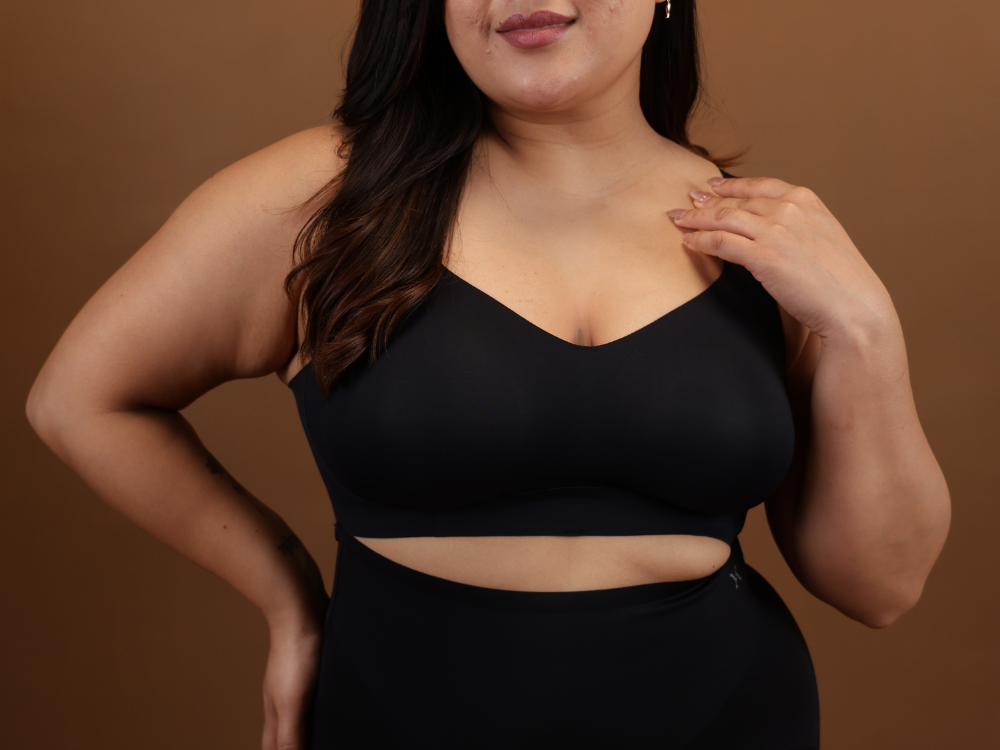
New bras should fit comfortably on the loosest hook. As the elastic relaxes with wear and washing, you move to the tighter hooks to keep the same firmness. A wireless everyday style makes this easy to feel, since the support comes from the band and fabric rather than a wire. Krvvy’s Trueform Support Bra is built around a firm, wide band in standard and plus sizes, which is the kind of construction that keeps the support where it belongs.
The signs your bra does not fit
Once you know what to look for, a bad fit is easy to spot in a mirror. These are the usual culprits.
The band rides up at the back. As covered above, this is the most common sign, and it means the band is too big. Try a smaller band size.
The straps dig into your shoulders and leave grooves. This usually means the straps are carrying too much of the load because the band is too loose, or the straps are simply too tight. Loosen the straps first, and if the support then disappears, the band is the real problem.
The cups gape or wrinkle. If there is empty space at the top of the cup or the fabric puckers, the cup is too big for you in that style. If your breast tissue spills over the top, the sides or under the arm, the cup is too small.
Wires sit on your breast instead of behind it. On an underwired bra, the wire should sit flat against your ribcage, following the crease under the breast and encircling all of the breast tissue. If it rests on the breast or pokes, the cup is too small or the wrong shape for you.
You pop out of the bottom. If breast tissue escapes below the band or the band and cup sit away from your body in the centre, the fit is off, often a cup or band issue together.
If two or three of these sound familiar, you are in good company. Fit surveys have suggested for years that most women are wearing the wrong size, which is exactly why this is worth a proper look rather than a guess.
Your size is not one fixed number
This trips people up constantly. You get measured once, you learn your size, and you treat it as fixed forever. In reality your size shifts with weight, your cycle, age and pregnancy, and it varies between brands and even between styles from the same brand. A 36C in one label can fit like a 34D in another. That is not a mistake on anyone’s part, it is just how cut and construction differ. Krvvy, Clovia, Zivame and Enamor will each fit slightly differently, so treat the number on the label as a starting point rather than a verdict, and let how the bra actually sits be the final word.
This is why trying a bra on and checking the fit matters more than trusting the size on the tag. A smooth, structured style is the easiest place to see whether the cups sit clean against you. If you want a bra that shows the fit clearly under fitted tops, a t-shirt bra like Krvvy’s Flawless Fit T-Shirt Bra has smooth moulded cups that make gaping or spillage obvious at a glance.
Sister sizes, the fix nobody explains
Here is a genuinely useful trick. If the cup volume feels right but the band is too tight or too loose, you do not have to start from scratch. You move to a sister size, which keeps the cup volume the same while changing the band.
The rule is simple. If the band is too tight, go down a band size and up a cup letter (say 36C becomes 34D). If the band is too loose, go up a band size and down a cup letter (36C becomes 38B). The cup volume stays roughly the same, so you keep the part that was working and fix the part that was not. Keeping a couple of sister sizes in mind is the fastest way to solve a near-miss without giving up on a bra you otherwise like.
Checking your fit at home
You do not need an appointment or even a tape measure to do a first check. Put on an unpadded or lightly lined bra, stand in front of a mirror, and run through this.
Look at the back band. Is it level with the front, or riding up? Slide two fingers under the band. It should feel firm, with just enough room for the fingers, not loose enough to pull far off your body. Check the front centre, the bit between the cups, and see whether it sits flat against your breastbone. Look at the cups from the side and front for gaping or overflow. Then lift your arms over your head. If the band rides up and stays up, it is too loose.
If you want to put a number to it before you shop, our guide to measuring your bra size at home walks through the band and cup measurements, and what A, B, C and D cups actually mean explains how the letters work. Use the number to pick a starting size, then let the mirror test decide.
None of this is about chasing a perfect measurement. It is about noticing what your body is already telling you, and giving yourself permission to stop blaming yourself for a bra that was never going to be comfortable.
Frequently asked questions
How should a bra fit? A bra fits when the band sits firm and level around your ribcage and does most of the supporting work, the cups hold everything with no gaping or spilling, and the straps stay on your shoulders without digging in. You should be able to move, reach and raise your arms without the bra shifting, and ideally forget you have it on.
Why does my bra ride up at the back? Almost always because the band is too loose. The band should sit level with the front of the bra, and if it climbs towards your neck, going down a band size usually fixes it. Tightening the straps will not solve a loose band, it will just leave your shoulders sore.
Why do my bra straps dig into my shoulders? Usually because the straps are carrying too much weight, which happens when the band is too loose and cannot do its job. Loosen the straps a little, and if the support disappears, the band is the real issue. Wider, cushioned straps and a firmer band spread the load and stop the digging.
What is a sister size? A sister size keeps the cup volume the same while changing the band size. If the band is too tight, go down a band and up a cup letter; if it is too loose, go up a band and down a cup letter. It is the quickest way to fix a bra where the cup is right but the band is not.
How do I know if my cup size is too small? If breast tissue spills over the top, the sides or under the arm, or the underwire sits on the breast instead of behind it, the cup is too small. You may also see the centre panel lift away from your breastbone. Going up a cup size, or trying a sister size, usually resolves it.
Should a bra feel tight? Firm, not tight. The band should feel snug and secure with room for two fingers underneath, but it should not pinch, leave deep marks or make it hard to breathe. If it hurts or digs in, the size or style is wrong, and comfort is the sign you are looking for, not tightness.
Reviewed by the Krvvy Content Team, September 2026.